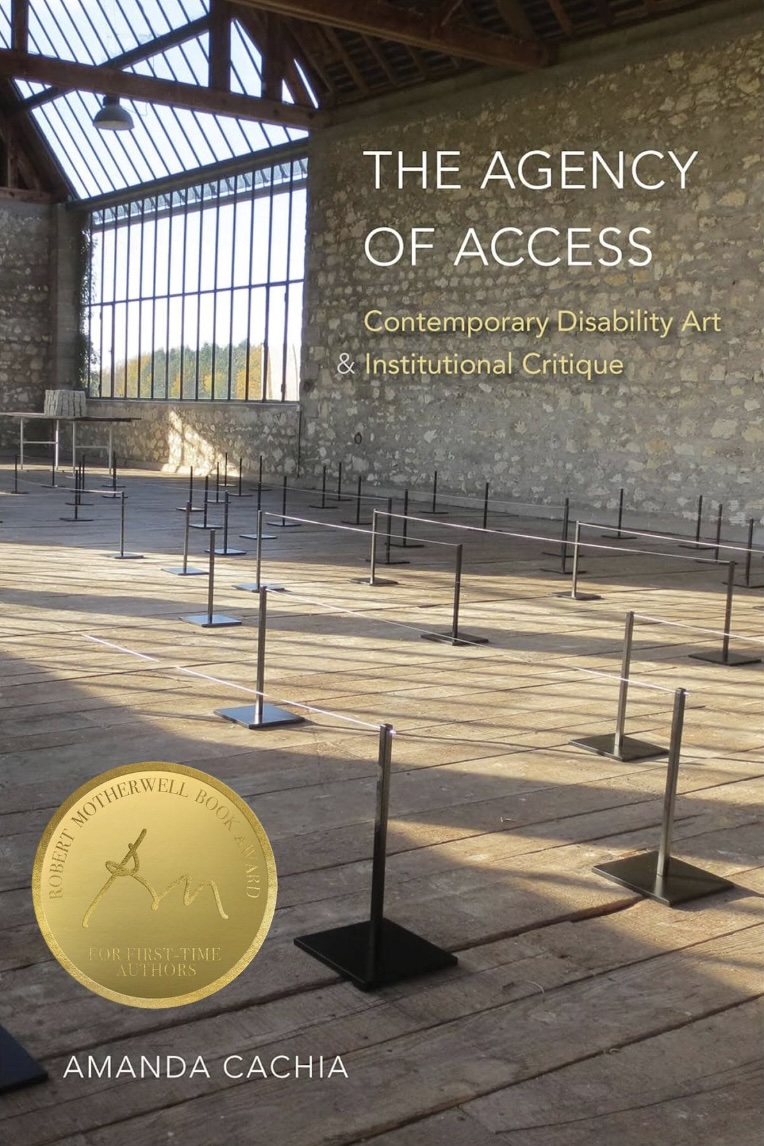
Bibliographic Reference
Amanda Cachia, The Agency of Access: Contemporary Disability Art and Institutional Critique, Philadelphia: Temple University Press, 2024. Winner of Dedalus Foundation 2026 Robert Motherwell First Book Award. Shortlisted for the College Art Association 2026 Charles Rufus Morey Book Award.
In The Agency of Access: Contemporary Disability Art and Institutional Critique, I argue that contemporary disabled artists are moving away from representations of disability, instead creating an art of access, or access aesthetics, through artworks that center translation, sensory expansion, touch, and movement for audiences that offer an experience of “being with” disability. By making inequities in the museum more transparent, artists are also engaging in institutional critique, demanding agency, voice, empowerment, and social justice. On a broader level, this book also shows how disability art extends and repurposes art historical precedents in directions that compel us to regard the artistic past differently.
Reviews:
“The Agency of Access is a comprehensive book about the artistic and curatorial movement to ‘de-normalize’ art institutions…. (Cachia’s) book fills the gaps in the limited but growing scholarship on disability as method and the sensorial evolution in museum disability aesthetics.”
—Journal of Curatorial Studies
“(A) key aspect of the book is its thorough contextualization of contemporary disability art in relation to the canon of 20th century art history…. Cachia admirably examines the overlapping forms of oppression disabled people experience along the lines of gender, race and colonialism.”
—Field
“Cachia’s tome is a thoughtful and valuable contribution to wider discussions about how to increase access to art in institutional settings. In particular, it calls attention to how an expanded appreciation of the senses, through the work of artists with disabilities, highlights deficits in our current attempts at accessibility. Perhaps most importantly, the book also draws attention to the complexities involved as we account for and appreciate human variation…. The Agency of Access is an important step forward.”
—CAA Reviews